

EV Onboard Charger Capacitors determine how steady the DC bus stays while an OBC converts grid power into battery charging power. In the DC-link position, the choice between film and electrolytic depends on ripple current. It also depends on ESR loss. Temperature rise matters as well. Lifetime is important too. Packaging and cost play key roles. Film capacitors suit many high-reliability DC-link designs. Electrolytic capacitors can work when capacitance density and upfront cost dominate.
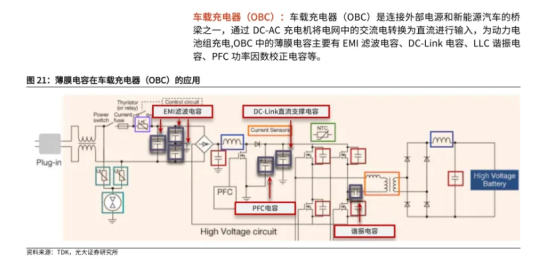
An EV onboard charger DC-Link capacitor sits between power conversion stages. It stabilizes the intermediate DC bus. This happens before downstream conversion supplies the battery. In a typical AC charging OBC structure, the DC-link position works after the PFC stage. It comes before the LLC stage. As a result, it lowers bus-voltage fluctuation during switching pulses. It handles grid variation and load changes. The capacitor affects voltage stability. It influences semiconductor stress. It impacts heat generation. It also affects conducted noise and conversion efficiency.
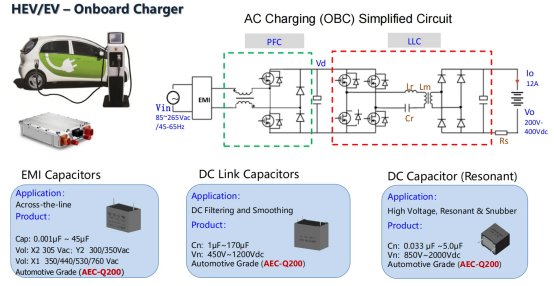
OBC capacitor selection is demanding. Charging cycles last long. Switching frequency runs high. Vehicle space remains compact. Ripple current heats the capacitor core. Nearby power electronics speed up aging. The HEV/EV onboard charger application separates EMI Capacitors, DC link capacitors, and DC Capacitor (Resonant) positions. Each part must be chosen for its own electrical stress. Capacitance value alone is not enough.
In the film capacitor vs electrolytic capacitor decision, film parts are usually chosen when low ESR matters. High-frequency current handling counts too. Long service life becomes more important than maximum capacitance per volume. SMILER capacitor DC-Link Capacitor products use metallized polypropylene film and are used in DC-Link circuits. The approved DC-link family lists low ESR. It offers high ripple current handling capability. It provides low self-inductance. It includes a self-healing property and long lifetime. Applications include EV or HEV transportation and renewable-energy inverters. These characteristics explain why a DC-Link Capacitor is often considered for automotive DC bus filtering.
Electrolytic capacitors have a different value proposition. They can provide high capacitance density. They offer lower initial cost when a design needs large bulk capacitance. They require enough space, airflow, and maintenance margin. Their weaknesses relate to electrolyte aging. They show temperature sensitivity and ripple current limits. High RMS ripple current can raise internal temperature. Over time, that can increase ESR and reduce useful life. An EV charger capacitor comparison should examine power loss. It should review heat rise, endurance, mounting, reliability target, and service environment.
Ripple current is one of the first numbers to check. It turns into heat inside the capacitor. The loss is related to ESR. A lower ESR device can reduce internal heating under the same ripple-current duty. Engineers should calculate or simulate RMS ripple current at the DC-link point. Then they compare it with the capacitor's rating at the actual frequency and ambient temperature. For DC-Link capacitor design for electric vehicles, consider ripple current together with the cooling path. Terminal current density matters. Layout inductance is important too.
Voltage rating should include margin above the nominal DC bus. It must account for grid tolerance. Load transients are part of it. Battery-side events matter. Test conditions count as well. The HEV/EV onboard charger scenario lists DC-link capacitors for DC filtering and smoothing. Capacitance ranges from 1 uF to 170 uF. Voltage ranges from 450 VDC to 1200 VDC. That OBC DC-link position is marked Automotive Grade (AEC-Q200). Those values are useful as an application range. Lifetime still depends on voltage stress. It relies on RMS current, case temperature, thermal resistance, and mission profile.
EV charger capacitor design must fit a small package. The package faces vibration and stays thermally dense. Electrolytic parts may reduce volume for large capacitance banks. Film DC-link designs can reduce parallel count when ripple-current stress and ESR heating are the main limits. Lead spacing matters. Busbar connection is important. Mounting direction counts. Creepage and clearance affect the design. Potting material influences power density too. A compact capacitor is only useful if heat, insulation, and current stress stay within limits.
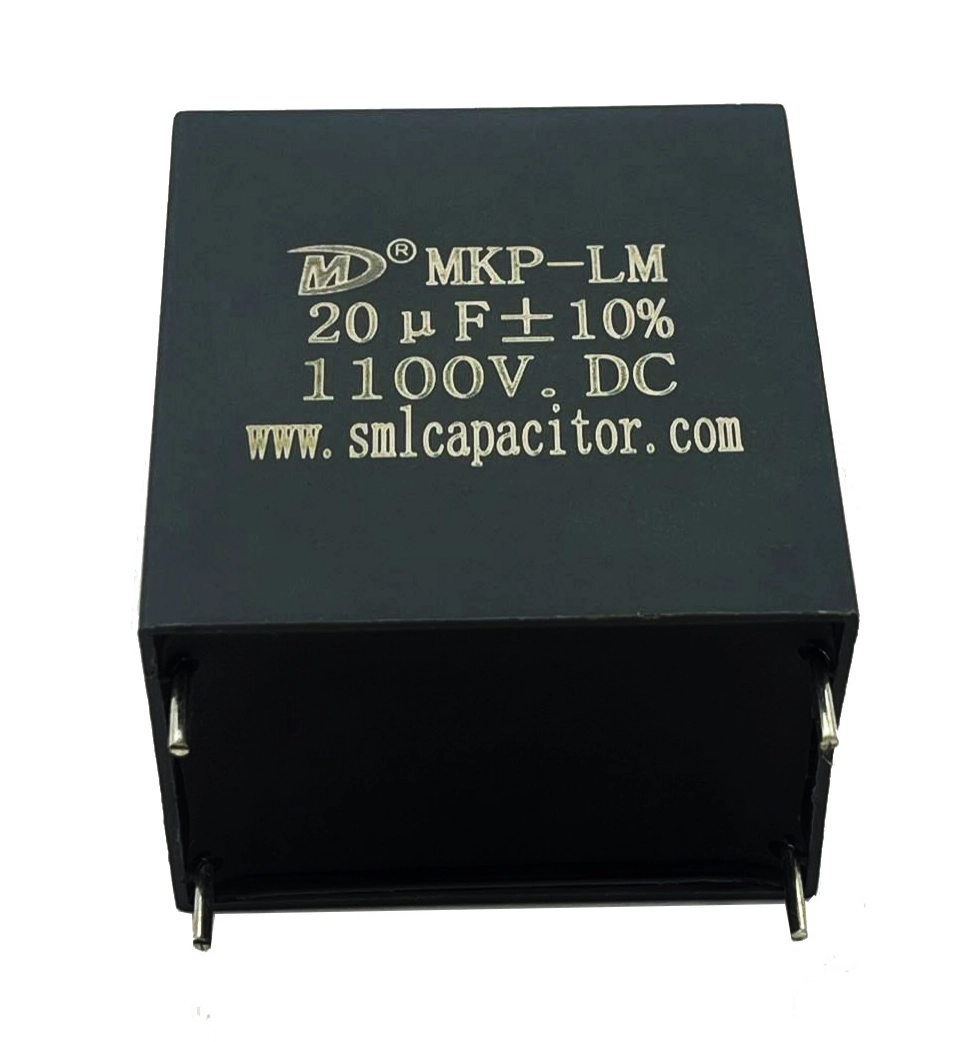
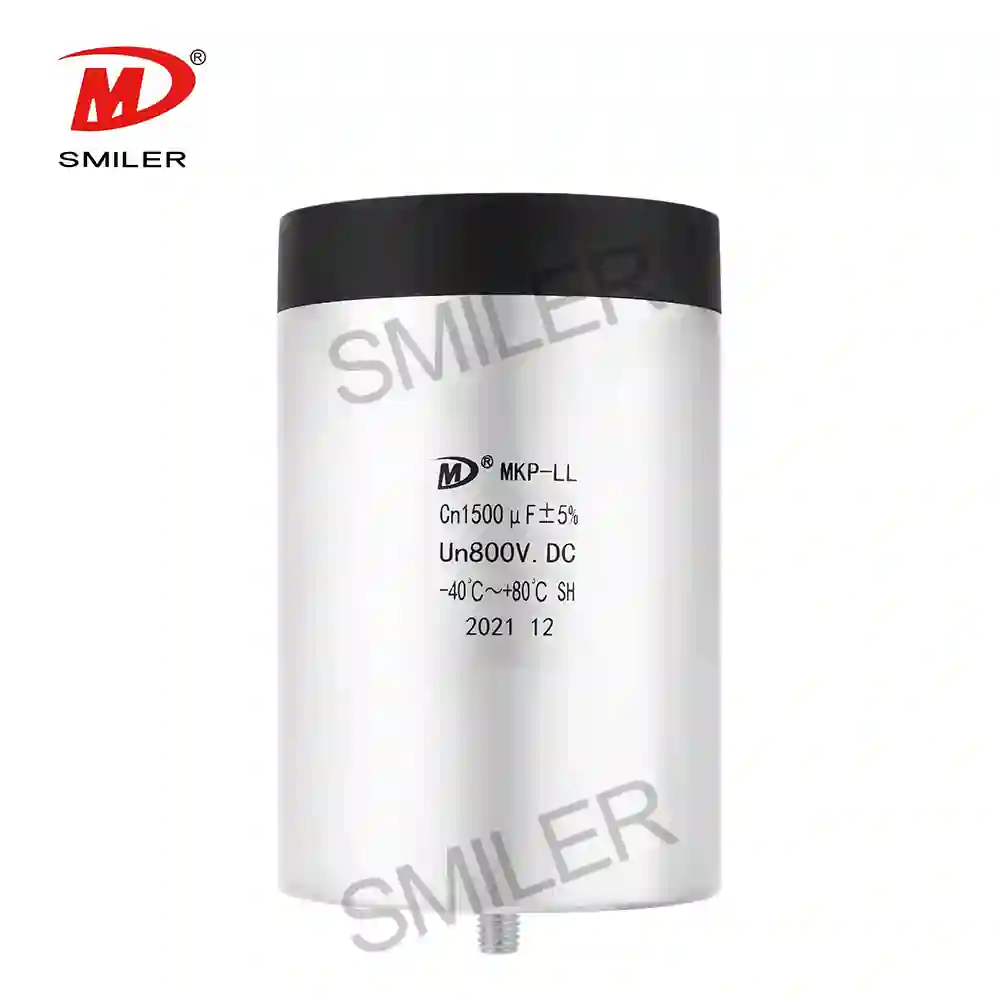
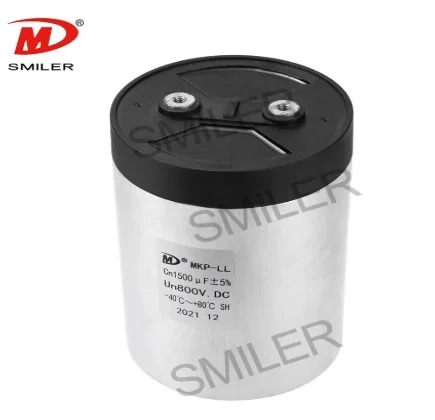
A film DC-link capacitor for EV charger designs is a strong option when the OBC needs high ripple current capability. Stable high-frequency performance counts. A long lifetime target is essential. The Power Capacitor DC Link Capacitor MKP-LL is a dry-type aluminum-case DC link capacitor used for DC filtering and smoothing. It is used in DC-Link circuits, renewable energy, industrial drives, and traction applications. Its approved features include low ESR. It provides high ripple current handling capability. It offers low self-inductance. It includes a self-healing property and long lifetime. It meets GB/T 17702 and IEC 61071 reference standards. It has RoHS compliance and CE and UL 810 compliance. For automotive DC-Link capacitor options, the Power Capacitor DC Link Capacitor MKP-LL shows how a film product family can support demanding DC bus applications.
Electrolytic capacitors can still be practical in cost-sensitive chargers. They fit lower lifetime designs. They work in prototypes. They suit systems where the thermal environment is controlled, and replacement risk is acceptable. They may also help where high bulk capacitance matters most. Flexible packaging space is another factor. Review lifetime curves. Check ESR change over temperature. Examine ripple-current derating. Consider failure mode and maintenance expectations. A related SMILER capacitor engineering article on Film vs Electrolytic Capacitors can support broader AC-DC converter comparison thinking.
Common reliability threats include excessive temperature. Ripple-current stress is another threat. Overvoltage can cause problems. Vibration affects reliability. Poor thermal path reduces performance. Aging plays a role too. In electrolytic capacitors, electrolyte degradation is a major life limiter. In film capacitors, high hot-spot temperature can reduce margin. Overvoltage affects them. Pulse stress matters. Poor mechanical integration can limit performance. A DC-Link capacitor lifetime estimate should use capacitor temperature. It should include ripple-current spectrum. Bus voltage profile is important. Charger duty cycle must be considered.
Use derating first. Select voltage with room for real operation. Choose RMS ripple current carefully. Add thermal margin. Include insulation rating with extra allowance. SMILER capacitor has over 15 years of film capacitor expertise. Our customization support helps. Low MOQ availability is offered. Automated production lines focus on efficiency. They ensure precision, consistency, and quality control. Final suitability still depends on engineering verification. Validate the capacitor in the assembled OBC under expected heat. Check it under load, frequency, vibration, and charging cycles before release.
A: EV Onboard Charger Capacitors support filtering. They help with smoothing and noise suppression. They aid resonance and DC bus stabilization inside the charger. In the DC-link position, they help keep the intermediate DC voltage steady between conversion stages.
A: Film capacitors are often better for high ripple current. They suit low ESR needs. They provide high-frequency performance and long-life requirements. Electrolytic capacitors can still fit cost-sensitive or high-capacitance-density designs when thermal and lifetime limits are acceptable.
A: Start with DC bus voltage. Consider capacitance next. Check RMS ripple current. Review ESR and ESL. Examine temperature and lifetime target. Look at package size, insulation, and mounting. Then verify the choice in the actual OBC profile.
A: Film capacitors are used because metallized polypropylene designs can offer low ESR. They provide high ripple-current handling. They deliver low self-inductance. They include self-healing behavior and long service life in suitable DC-link applications.
A: Lifetime depends on technology. Temperature plays a part. Ripple current affects it. Voltage margin matters. Mission profile is important too. A properly derated film DC-link capacitor can support long-life charger designs. The actual lifetime must be validated under real operating stress.
DC Decoupling Capacitor: Is It Essential for Your Circuit Stability?
DC Link Capacitor: Enhancing Power Stability in High Speed Trains
How Link Capacitors Stabilize DC Bus Voltage in Inverters
How a Capacitor Charges in a DC Circuit: A Detailed Analysis
How DC Coupling Capacitors Differ from AC and DC Blocking Capacitors


 Add
Building 12,Huazhi Technology Innovation Center,28 Sanle East Road,Beijiao,Foshan,Guangdong,China
Add
Building 12,Huazhi Technology Innovation Center,28 Sanle East Road,Beijiao,Foshan,Guangdong,China
 Phone
+86 18007576965 / 0757-22391591
Phone
+86 18007576965 / 0757-22391591
 Email
ari@sml-cap.cn
Email
ari@sml-cap.cn



